Park, Library or Market: Compare Amenities by the Day They Serve
Compare parks, libraries and markets by the days you would use them, so a city’s amenity list reveals which places fit your needs and schedule.
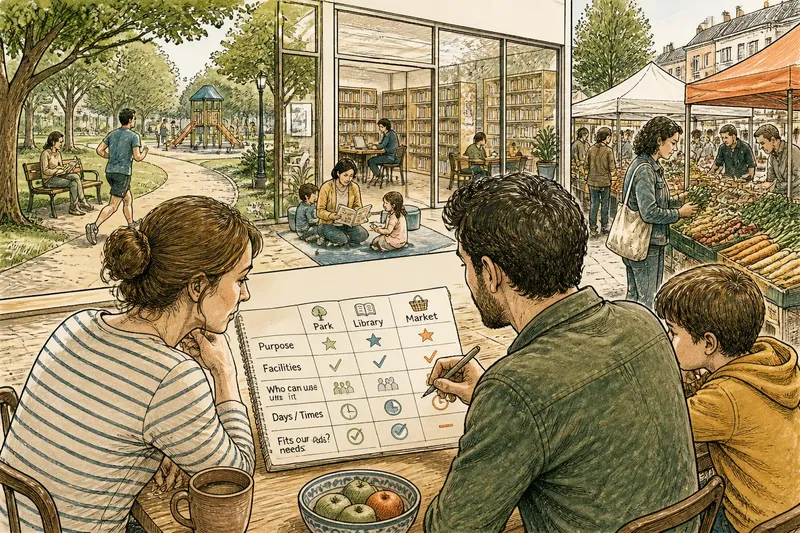
You have a library book due, a bag of groceries to buy and a little time before dinner. A park, library and market may all be nearby, but each offers a different kind of value. Comparing amenities by the day they serve makes a city’s list of destinations easier to judge.
A park might offer a place to stretch your legs; a library can provide books, work space or public activities; a market may supply ingredients or a sociable outing. The useful question is not how many amenities appear on a map. It is what each place offers, who can use it and whether its facilities and schedule suit your needs.
Start with the purpose each place could serve
List the activities you would genuinely value: a quiet place to read, room for children to play, a path for a short walk, or somewhere to buy particular ingredients. Keep these purposes distinct. That makes it easier to spot the difference between an amenity you would rely on and one you might enjoy occasionally.
Next, note practical details that affect each purpose. For a park, consider paths, seating, play equipment or space for informal sport. For a library, check its facilities and programme. For a market, look at its goods and operating days. These details make “nearby” more meaningful without turning a city comparison into a simple count.
Imagine you are comparing two neighbourhoods. In one, the park has a path and benches, the library offers a study area, and the market sells ingredients you use but opens on a day that does not suit your household. In the other, the park has play equipment, the library runs activities for children, and the market operates when you usually shop. If child-friendly facilities and convenient food shopping matter most to you, the second neighbourhood appears to fit better; if a quiet walk and study space matter more, the first may suit you. The result depends on the priorities you wrote down, not on a universal ranking.
Write each amenity’s likely purpose next to its name before comparing neighbourhoods.
Judge parks by their features and setting
“Park” can mean a broad lawn for games, a shaded path, a small square with benches or a play area beside busy streets. Ask what the space can accommodate and who is likely to use it. A parent with a pram, a runner, a dog walker and someone seeking a quiet lunch break may look for different features.
Consider whether the park’s design fits the activity you have in mind. Paths can make a short walk easier; benches offer a place to pause; a lawn may suit informal games. A large park can be a destination for a planned outing, while a smaller green space may offer a convenient place to sit. Size alone does not tell you which would be more useful.
If a particular facility or visiting time matters, check current local information. Opening arrangements and available features can vary from one park to another.
Look beyond books when comparing libraries
A library may offer desks, children’s areas, computers, classes, exhibitions or a quiet place to sit. The right details depend on what you want to do there. Someone seeking a study space may care about desks; a family may look for children’s activities; another visitor may simply want somewhere calm to read.
Check a branch’s current facilities and schedule rather than judging it by a special event alone. An activity only suits your comparison if its timing and format work for the people who might attend. Opening hours matter too: a branch may be well equipped yet hard to use at the times available to you.
Also note whether the library works as a destination in its own right or offers a service you can use while visiting nearby places. If borrowing books is not your priority, the branch may still matter for its public spaces or activities.
Separate market shopping from market outings
Markets differ in what they sell, when they operate and how people use them. A food market may suit a planned shop; another market may be more appealing for prepared food, browsing or a public gathering. Find out what is available before treating “market nearby” as a sign of convenient shopping.
Think about the goods you would actually buy. If the stalls suit your needs and the market operates at a convenient time, it may serve a practical purpose. If you would mainly browse, count it as an occasional destination rather than a regular source of groceries. Both kinds of value matter, but they are not interchangeable.
Notice whether a market seems suited to a quick visit or a longer wander. Familiar vendors and a lively public setting may be part of its appeal, even when your shopping list is short.
Check the details that can change your ranking
Before comparing neighbourhoods, check the details behind each amenity. Each observation should lead to a clear choice, including an alternative if the place does not fit.
- Park facilities: Check for the feature you need, such as a path, bench or play area. If it is present, count the park for that use; if not, look for another nearby space or leave that use out.
- Park setting: Observe whether the space suits a quiet pause, active play or informal sport. If it matches your intended activity, keep it on the shortlist; if not, compare a park designed for that purpose.
- Library services: Check whether the branch has the service you want, such as a study area, children’s space or public programme. If it does, include that benefit; if it does not, consider another branch or a different kind of public space.
- Library schedule: Check current opening hours and activity times against when you could attend. If they fit, count the service as accessible to you; if they do not, treat it as an occasional option or exclude it from regular-use comparisons.
- Market goods: Check whether the stalls offer things you would buy. If they do, count the market as a possible shopping destination; if they do not, assess it as a place to browse or leave it off your practical list.
- Market operating pattern: Check which days the market runs. If those days suit your plans, include it for that purpose; if they conflict, look for another place to shop and count the market only as an occasional outing if that still appeals.
- Different household needs: Ask each person which facility or activity they would use. If a place serves someone’s stated need, record that benefit separately; if nobody expects to use it, do not add it to the shortlist merely because it sounds attractive.
Use these observations to compare what each place actually offers, rather than treating all parks, libraries and markets as equivalent.
Which questions help you compare amenities?
Does a larger park always offer more value?
No. A small space with a bench or path may suit a short visit, while a larger park may be more useful for sport or a longer outing. Compare the features with the activity you have in mind.
Can a library matter if you do not borrow books?
Yes, if you would use its other facilities or activities. Check what the branch offers and whether its opening hours and programme suit you.
Can a weekly market serve as an ordinary food shop?
It can if its operating day and goods match your needs. If you would mostly browse, compare it as a leisure destination rather than a dependable source of everyday shopping.
How should you compare places valued by different people?
Record each person’s intended use separately instead of folding every preference into one vague rating. A place can matter greatly to one household member and have little appeal to another.
Build a shortlist from actual amenities
For each neighbourhood, record one park feature, one library service and one market purpose that could matter to you. Mark each as a regular option, an occasional attraction or not a current fit. Leave a category blank if you cannot name a use; there is no need to invent one.
Then compare like with like. A park with a path and a park with play equipment answer different needs. A library with a study area and one with a programme for families serve different visitors. A market for planned shopping is not the same proposition as a market for a leisurely browse.
Check current local details before relying on a particular facility, schedule or service. For a more useful comparison of parks, libraries and markets, keep the main search phrase in mind as a practical question: what does each amenity offer, and does that fit your needs?
A destination earns a place on your shortlist when you can name the feature or service that matters to you. That small distinction keeps a lively map from standing in for a useful one.